



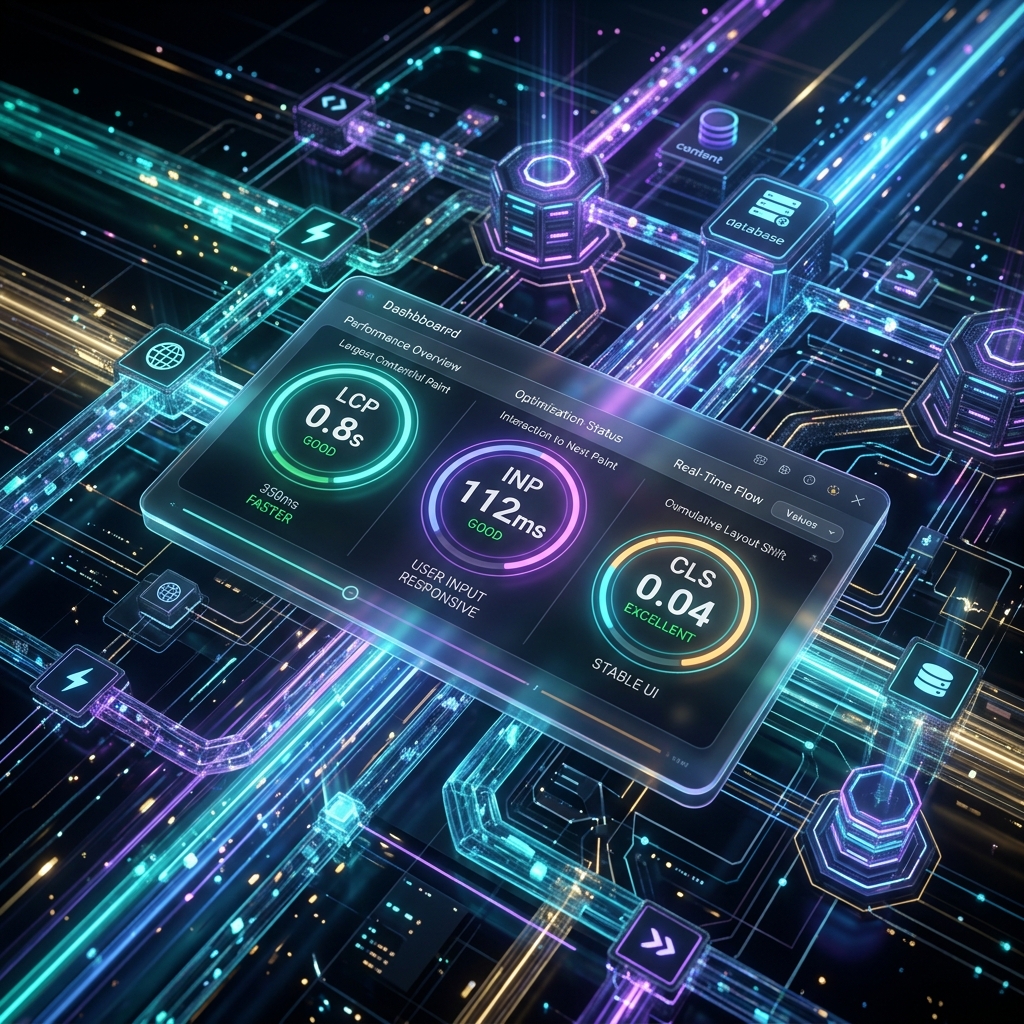
In the early days of the web, performance was evaluated by a simple metric: page load time. If a site rendered in under three seconds, it was considered fast. In mid-2026, user expectations and search algorithms have evolved dramatically. Speed is no longer defined by a single static timer, but by the continuous responsiveness of the page across a user's entire session. Welcome to the 2026 Web Performance Playbook—where we optimize not just for rendering, but for interaction, fluidity, and edge compute efficiency.
For modern web applications, particularly those powering dynamic e-commerce, enterprise dashboards, and agency platforms, delivering sub-millisecond Core Web Vitals is a primary competitive advantage. This article breaks down how cutting-edge development teams are orchestrating edge rendering, hybrid patterns, and selective hydration to redefine the limits of web speed.
1. The Evolution of Speed: Why Core Web Vitals Matter More in 2026
Google's Core Web Vitals—comprising Largest Contentful Paint (LCP), Cumulative Layout Shift (CLS), and Interaction to Next Paint (INP)—represent the industry standard for measuring real-world user experience. In 2026, these metrics are more critical than ever. Search engines penalize sites with sluggish UI threads, and conversion data consistently proves that every 100ms of delay in LCP reduces checkouts by up to 8%.
To succeed, developers must shift from ad-hoc optimization to a structural performance budget, integrating automated diagnostics directly into their CI/CD pipelines.
2. Demystifying INP: The Modern Benchmark for Interaction Responsiveness
The transition from First Input Delay (FID) to Interaction to Next Paint (INP) as a primary Core Web Vital represented a fundamental shift in how responsiveness is measured:
- First Input Delay (FID): Only measured the latency of the very first interaction. If a site was slow during the rest of the visit, FID remained blind to it.
- Interaction to Next Paint (INP): Monitors all interactions (clicks, taps, keypresses) during the entire lifecycle of a page. It reports the longest delay between the user's action and the next visual update on the screen.
To keep INP under the 200ms "good" threshold, developers must optimize event handlers, avoid blocking JavaScript execution on the Main Thread, and yield to the browser paint cycle using techniques like requestIdleCallback and scheduler.yield().
3. Edge Rendering: Moving Compute to the User's Doorstep
Server-Side Rendering (SSR) has long been the standard for dynamic SEO-friendly websites. However, traditional SSR relies on centralized servers (e.g., in AWS us-east-1 or Mumbai regions), creating geographic latency for global users. In 2026, we resolve this through Edge Rendering.
By leveraging CDN edge runtimes (such as Cloudflare Workers, Vercel Edge, or Netlify Functions), developers can execute SSR logic in serverless functions running within miles of the user. This reduces Time to First Byte (TTFB) to double-digit milliseconds, paving the way for instantaneous LCP rendering worldwide.
4. Hybrid Architectures: Balancing SSR, SSG, and ISR
No single rendering strategy fits an entire modern website. A homepage might benefit from Static Site Generation (SSG), while a search page requires real-time Server-Side Rendering (SSR), and product pages are best suited for Incremental Static Regeneration (ISR).
Modern meta-frameworks like Nuxt 4 and Next.js 15 allow developers to define rendering rules on a per-route basis. By combining static shells with dynamic edge-rendered islands, websites can deliver the load speed of a static document along with the personalization and real-time data of a fully dynamic app.
5. Island Architectures & Fine-Grained Hydration
The single greatest bottleneck to INP on modern web pages is hydration—the process where a browser downloads, parses, and executes a large JavaScript bundle to make static HTML interactive. During this time, the Main Thread is blocked, and user inputs are frozen.
To eliminate this bottleneck, developers are adopting Island Architectures and Fine-Grained Hydration. Instead of hydrating the entire page at once, pages are structured as static HTML with small, isolated "islands" of interactivity. JavaScript is only downloaded and executed for those specific islands when they become visible (lazy-hydration) or when the user initiates an interaction (hydrate-on-demand).
6. Optimizing the Critical Rendering Path: Preloading, Fonts, and Images
Beyond rendering paradigms, traditional front-end optimizations remain crucial for LCP and CLS:
- Fetch Priority and Preloading: Assign
fetchpriority="high"to hero images and preload critical fonts so the browser discovers and downloads them before parsing stylesheets. - Explicit Dimensions: Always define width and height attributes on images and reserve layout boxes for dynamic ad placeholders to prevent Cumulative Layout Shift (CLS).
- Font Display Swap: Use
font-display: swapalong with local fallback fonts matching system metrics to prevent FOIT (Flash of Invisible Text) while minimizing layout shifting.
7. The Outlook: Emerging Technologies Shaping Web Performance
Looking ahead, several emerging browser capabilities and protocols will push web performance even further:
WebGPU and WASM: Bringing near-native computing efficiency to the client, WebGPU enables rich, GPU-accelerated 3D graphics in the browser, while WebAssembly (WASM) enables highly optimized heavy computation without stalling the UI thread. Additionally, HTTP/3 transport layers reduce connection handshake times, especially on unstable mobile networks.
Conclusion
Web performance in 2026 is an engineering discipline requiring coordination across CDN routing, framework compilers, and browser paint cycles. By embracing edge rendering, optimizing for Interaction to Next Paint, and minimizing hydration overhead, developers can build websites that load instantly and respond immediately. In the modern digital landscape, the fastest site doesn't just win the SEO race—it wins the customer.