The 9-to-5 workday was invented for the factory floor. In the **Knowledge Economy of 2026**, it is a fossil. The most productive companies—from tech giants to agile startups—have realized that synchronous meetings are the enemy of deep work.
This article explores the rise of the Async-First workplace, where "Calendar Bankruptcy" is a strategy, productivity is measured in output, and the Digital Nomad lifestyle is the norm.
1. The High Cost of "Quick Huddles" (The ROI of Silence)
A 30-minute meeting with 10 people isn't a 30-minute meeting; it's a 5-hour meeting. When you factor in the "context switching" cost—it takes 23 minutes to regain focus after an interruption—the damage to Operational Efficiency is catastrophic.
The Financial Impact: In 2025, companies that shifted to Async-First reported a 40% reduction in burn rate and a significant boost in employee retention. Why? Because autonomy is the ultimate benefit.
2. The "3 Ds" Rule for Meetings
If you call a meeting in 2026, it must pass the "3 Ds" test. If it doesn't, it's an email or a Loom.
- Discussion: Exploring a complex topic with unclear solutions (Brainstorming).
- Debate: Resolving conflicting viewpoints where emotional nuance is key.
- Decision: Making a final call on a high-stakes strategy (Go/No-Go).
Status updates are banned. If you are reading a slide deck to people, you are failing as a leader. This is the golden rule of Meeting Hygiene.
3. The Tech Stack of Freedom (AI-Enabled)
Async work requires better writing and smarter tools. "I'll tell you on the call" is lazy. The best teams write it down or record it.
The Ultimate 2026 Toolkit:
- Loom / Descript: For explaining visual concepts or giving code review feedback.
- Notion / Coda: For "One Pagers" that document strategy (The Single Source of Truth).
- Linear / Jira: For state-of-work tracking without pestering engineers.
- Otter.ai / Fireflies: AI Note-takers that join the few meetings you do have, so you don't have to.
4. Hiring in 2026: The Borderless Talent Pool
One of the massive keyword trends of 2026 is Time Zone Arbitrage. When you don't need everyone online at 9 AM New York time, you can hire the best developer in Poland, the best designer in Brazil, and the best marketer in Tokyo.
Global Recruitment is no longer a logistical nightmare; it's a competitive advantage. Async-first companies operate as a 24-hour machine, where work is "passed on" around the sun.
5. The "Writing Culture" Shift (Amazon & Stripe Model)
You cannot have an async-first company with a "verbal-first" culture. The companies winning in 2026—like Stripe and Automattic—are writing companies. They have replaced powerpoints with prose.
The "Six-Page Memo" Rule: Following Amazon's lead, serious decisions now start with a narrative document. Why? Because writing forces clarity. You can bluff your way through a presentation; you cannot bluff your way through a written memo.
6. Asynchronous Brainstorming (The "Silent" Ideation)
The biggest myth is that you need a room full of people to be creative. Research shows that groupthink kills innovation in live meetings. The loudest voice wins, not the best idea.
The New Workflow:
- Ideation Phase (Async): Everyone submits ideas anonymously to a Miro board over 24 hours. No bias.
- Review Phase (Async): Team votes and comments on ideas.
- Sync Meeting (Final): A short 15-minute call to align on the winner.
7. The Hybrid "Barbell" Strategy
Smart companies use a "Barbell Strategy" for strict separation.
- One End: Deep, isolated work (90% of the time).
- Other End: Intense, in-person retreats (10% of the time).
8. Calendar Bankruptcy & Focus Blocks
Top teams practice "Calendar Bankruptcy" once a quarter: delete every recurring meeting and only add back the ones that are absolutely vital. Most don't come back.
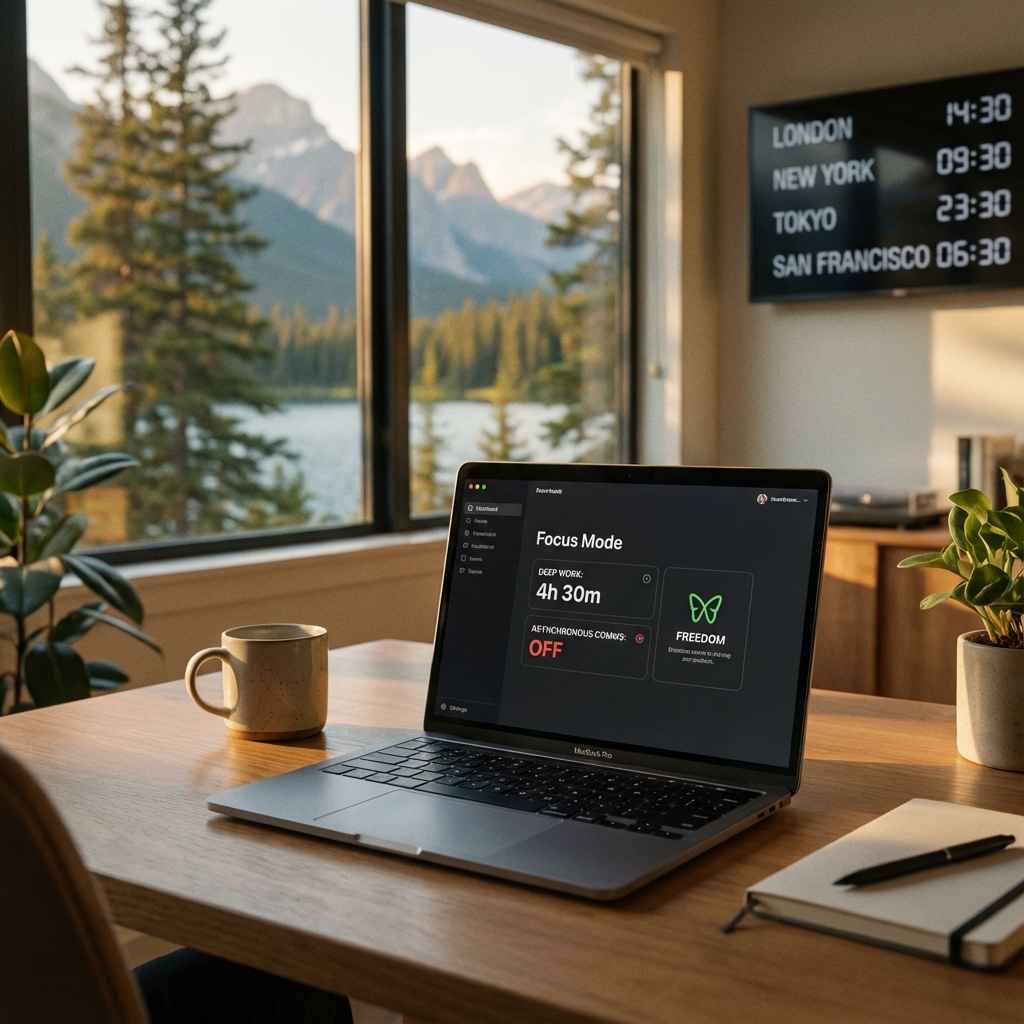
Focus Blocks: Companies now enforce "Core Hours" (e.g., 10 AM - 2 PM EST) for collaboration, leaving the rest of the day for protected, uninterrupted Deep Work.
9. Overcoming the "Always On" Anxiety (Slack Etiquette)
Async doesn't mean "reply immediately." It means "reply well." The pressure to show a green dot on Slack is toxic. Modern Slack Etiquette involves:
- Disabling notifications by default.
- Using "Schedule Send" to respect recipients' time zones.
- Using status emojis (Focus Mode 🧠) to signal unavailability.
Current Date Insight
As of December 28, 2025, the trend is clear: The companies forcing "Return to Office" (RTO) for the sake of oversight are losing top talent to the companies offering the autonomy of Remote-First protocols.
Conclusion
The future of work isn't about where you work; it's about how you work. Async-first isn't just efficient; it's humane. It respects the fact that we have lives outside of our screens. Welcome to the era of Asynchronous Mastery.