


For the past few years, artificial intelligence in the enterprise was synonymous with productivity tools: copilots that autocomplete code, draft emails, or search internal wikis. In mid-2026, we have crossed a major threshold. The conversation has shifted from individual assistive tools to Autonomous Agent Swarms—modular, collaborating AI networks that function as a scalable "silicon workforce."
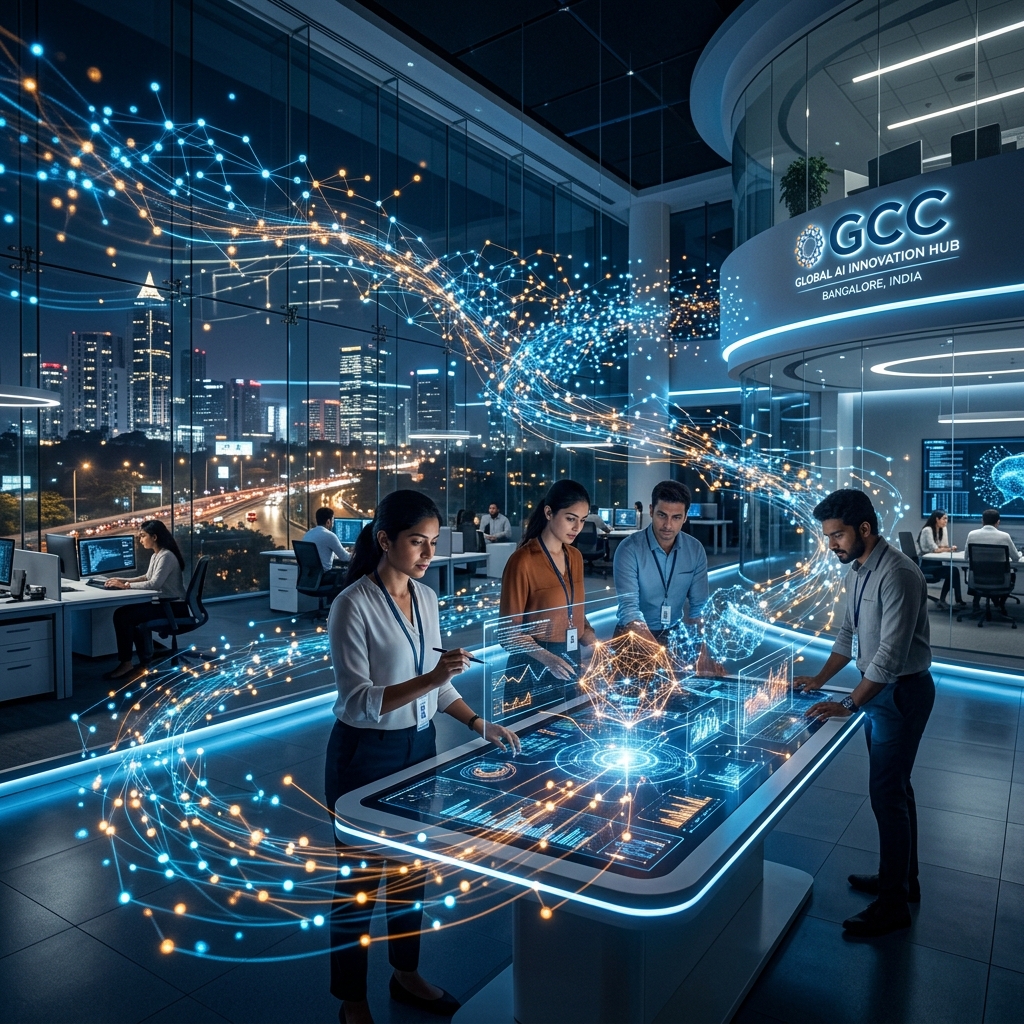
Nowhere is this transition more visible than in India’s Global Capability Centres (GCCs). Once regarded primarily as back-office cost centers, Indian GCCs in Bangalore, Hyderabad, and rapidly growing Tier-2 hubs like Coimbatore and Kochi have evolved into the primary innovation engines orchestrating these agentic networks for global enterprises.
1. The Shift to Action: From Generative to Agentic AI
Generative AI was a passive technology. It waited for a human to input a prompt, generated a single output, and went idle. Agentic AI, by contrast, is active. When given a high-level goal, an AI agent designs its own plan, selects and executes external tools, evaluates its progress, and adapts to obstacles.
In 2026, these agents do not work in isolation. They form multi-agent systems—or "swarms"—where specialized agents divide and conquer complex enterprise operations, coordinating autonomously to deliver business outcomes.
2. Enterprise Multi-Agent Systems: What are Agent Swarms?
To understand the silicon workforce, imagine a finance operations department. Instead of a human manually moving data between systems, a team of specialized AI agents handles the process end-to-end:
- The Intake Agent: Monitors incoming communication channels, extracts invoices, and converts unstructured data into standardized formats.
- The Verification Agent: Cross-references invoice amounts against purchase orders and receipts, identifying discrepancies.
- The Compliance Agent: Audits the transaction against regulatory frameworks and internal spend policies.
- The Treasury Agent: Interfaces with bank APIs to queue payments once approved.
These agents converse with one another using structured protocols. When a dispute arises, they don't crash; they pass the context to a human operator, resolving 90% of routine workflows autonomously and leaving only edge cases for human review.
3. The GCC Evolution: India as the Engine of the Silicon Workforce
The rise of agentic swarms is transforming the role of India’s GCCs. Historically valued for cost arbitrage, these centres are now the engineering hubs where multi-agent architectures are designed, tested, and deployed globally.
According to recent industry research, nearly two-thirds of new hires at Indian GCCs are focused on AI, data engineering, and intelligent orchestration. By owning the data pipelines and integration layers, GCC teams are uniquely positioned to connect foundational models with core enterprise databases, transforming raw AI capabilities into robust business systems.
4. Beyond Metros: The Tier-2 and Tier-3 Talent Surge
While Bangalore and Hyderabad remain powerhouse hubs, the talent pool for deep-tech and AI deployment is decentralizing. Cities like Coimbatore, Kochi, and Jaipur are witnessing a massive influx of GCC operations.
With highly rated engineering universities, lower cost structures, and excellent digital infrastructure, these Tier-2 and Tier-3 cities are no longer secondary options. They are active sites for designing autonomous systems, proving that high-end AI development in India is a nationwide phenomenon.
5. The Technical Architecture: Orchestrating Collaborative Agents
Building a successful agent swarm requires robust technical infrastructure. Enterprises are leveraging standardized multi-agent frameworks that manage communication, memory persistence, and state tracking:
Hierarchical vs. Peer-to-Peer Swarms: Swarms can be structured hierarchically—where a manager agent coordinates task distribution to subordinate specialists—or as peer-to-peer networks where agents publish and subscribe to a shared event stream. Keeping latency low requires local model compilation, often accelerated by custom silicon architectures like OpenAI's Jalapeño and edge TPU processors.
6. Overcoming Integration Bottlenecks: Security, Alignment, and Trust
Despite the immense potential, deploying autonomous agents at scale introduces significant engineering and governance challenges:
- Confidential Computing: Agents must access sensitive enterprise databases to be useful. To protect intellectual property and customer data, GCCs are implementing confidential virtual machines that execute models in encrypted hardware enclaves.
- Hallucination and Guardrails: Unlike standard software, agent behavior is non-deterministic. Developers must implement strict guardrails—such as semantic monitors and hard-coded policy validators—that restrict agent actions to predefined safety envelopes.
- Human-in-the-Loop (HITL): Designing intuitive interfaces that allow human operators to audit agent decisions, explain reasoning chains, and override actions is essential for maintaining trust and compliance.
7. The Outlook: The Future of Human-Agent Collaboration
As agentic swarms become standard operational infrastructure, the profile of the enterprise worker is changing. Job descriptions are shifting from manual data entry and repetitive processing to Agent Orchestration and Auditing.
Humans will act as supervisors and designers, defining the objectives, setting the safety constraints, and resolving complex edge cases. In this collaborative future, the value of the human workforce is elevated to strategic design and creative problem solving, while the digital workforce handles execution at scale.
Conclusion
The transition to autonomous agentic swarms represents the next phase of the digital revolution. By combining advanced AI model orchestration with India's deep pool of engineering talent, GCCs are proving that the future of enterprise operations is not just automated—it is agentic. The silicon workforce has arrived, and it is being built in Bharat.