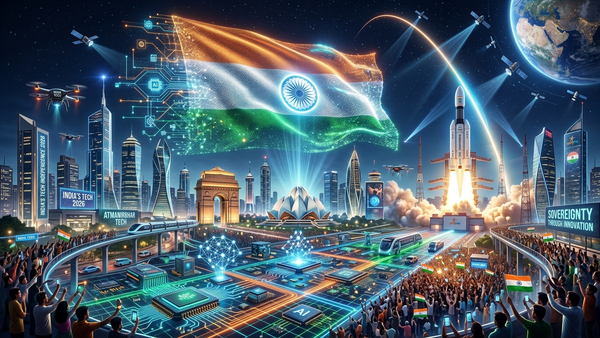




For decades, space exploration in India was the exclusive domain of the state, directed by the Indian Space Research Organisation (ISRO). But in 2026, the paradigm has shifted. Welcome to the era of Bharat's Private Space Tech, where a dynamic ecosystem of startups is design-engineering, building, and launching custom space assets into orbit.
This article explores how the confluence of liberalized policies, technical mentorship from ISRO, and advanced engineering technologies is transforming India into a premier hub for the commercial space economy.
1. The Opening of India's Heavens: The FDI Policy Shift
The turning point for the Indian space industry was the government's decision to open the space sector to 100% Foreign Direct Investment (FDI). This regulatory shift allowed global venture capital to flow directly into Indian space startups, bypassing bureaucratic bottlenecks.
By removing constraints on rocket launching, satellite manufacturing, and ground systems development, the policy created immediate confidence among global investors, accelerating the growth of local launch operators and satellite companies.
2. 3D-Printed Rockets: Agnikul Cosmos and Skyroot Aerospace
Indian startups are not just building rockets; they are redefining how they are manufactured. Companies like Agnikul Cosmos and Skyroot Aerospace are leading this innovation.
Agnikul Cosmos made history with the launch of its Agnibaan rocket, propelled by the world's first single-piece 3D-printed semi-cryogenic engine. By 3D-printing engines in a single run, they reduced manufacturing timelines from months to days, making custom launch missions highly cost-effective.
Meanwhile, Skyroot Aerospace is scaling its Vikram series of launch vehicles, designed specifically to deploy small satellites into low-Earth orbit (LEO) quickly and affordably.
3. Eye in the Sky: Low-Earth Orbit Constellations
Beyond launch vehicles, Indian space tech is building a presence in orbit. Startups like Pixxel and Dhruva Space are deploying advanced satellite constellations.
Hyper-spectral Imaging: Pixxel is launching a constellation of hyper-spectral satellites that capture light across hundreds of bands. This ultra-high-fidelity data enables industries to detect gas leaks, monitor crop health, and assess environmental damage before it becomes visible to standard optical satellites.
4. The ISRO Catalysis: IN-SPACe as an Accelerator
A key differentiator for India's space ecosystem is the cooperative relationship between the state and private enterprise. Rather than competing, ISRO actively supports startups through IN-SPACe (Indian National Space Promotion and Authorization Center).
IN-SPACe provides startups access to ISRO's world-class testing facilities, launch pads, and telemetry assets. This shared infrastructure drastically reduces the capital expenditure required for startups to build and test space hardware.
5. Global Launch Alternatives: India as the World's Spaceport
With global geopolitical changes restricting access to traditional launch providers, India has emerged as a reliable, cost-efficient, and neutral spaceport for global satellite operators.
By offering competitive launch pricing and regular launch cadences, local startups and the commercial arm of ISRO (NewSpace India Limited) are capturing a significant share of the global small satellite launch market.
6. Challenges in Private Space: Capital and Regulatory Risks
Despite the rapid acceleration, building space hardware remains a high-risk, capital-intensive endeavor.
- Capital Intensive Cycles: Developing space-grade hardware requires millions in upfront capital with long horizons before monetization.
- Regulatory Compliances: Satellites require global spectrum allocations (via the ITU) and strict space traffic management approvals, which can delay launch schedules.
7. The Outlook: Bharat's Trillion-Dollar Space Future
As the commercial space sector matures, its integration with downstream industries like telecommunications, agriculture, and defense is scaling.
By mastering precision manufacturing, localized testing, and custom launch services, India's private space sector is positioned to capture a major share of the global space economy by 2030, establishing Bharat as a dominant spacefaring nation.
Conclusion
The space tech revolution in India is a testament to what happens when state-of-the-art engineering meets bold entrepreneurship. As rockets ascend from Sriharikota, they carry more than just satellites—they carry the ambitions of a technologically sovereign nation. The future of space is no longer just observed; it is built.