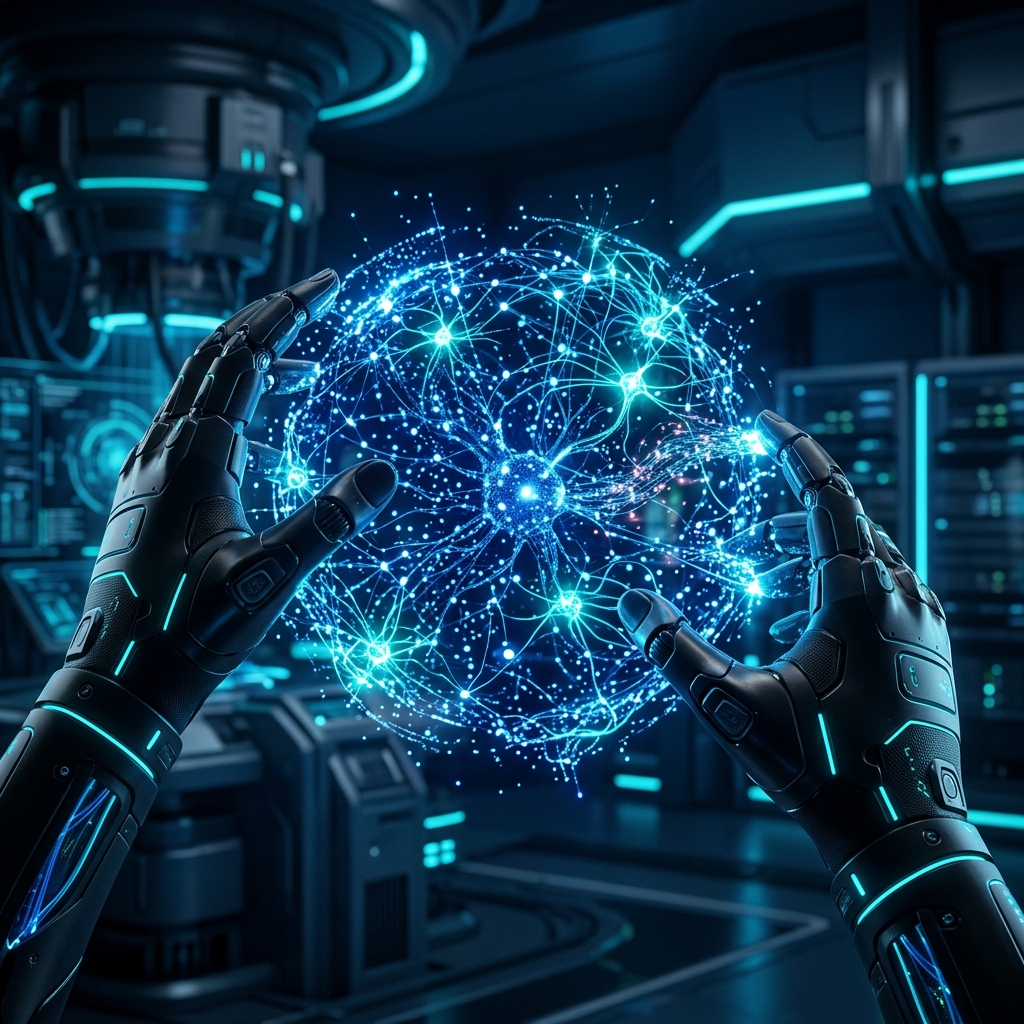
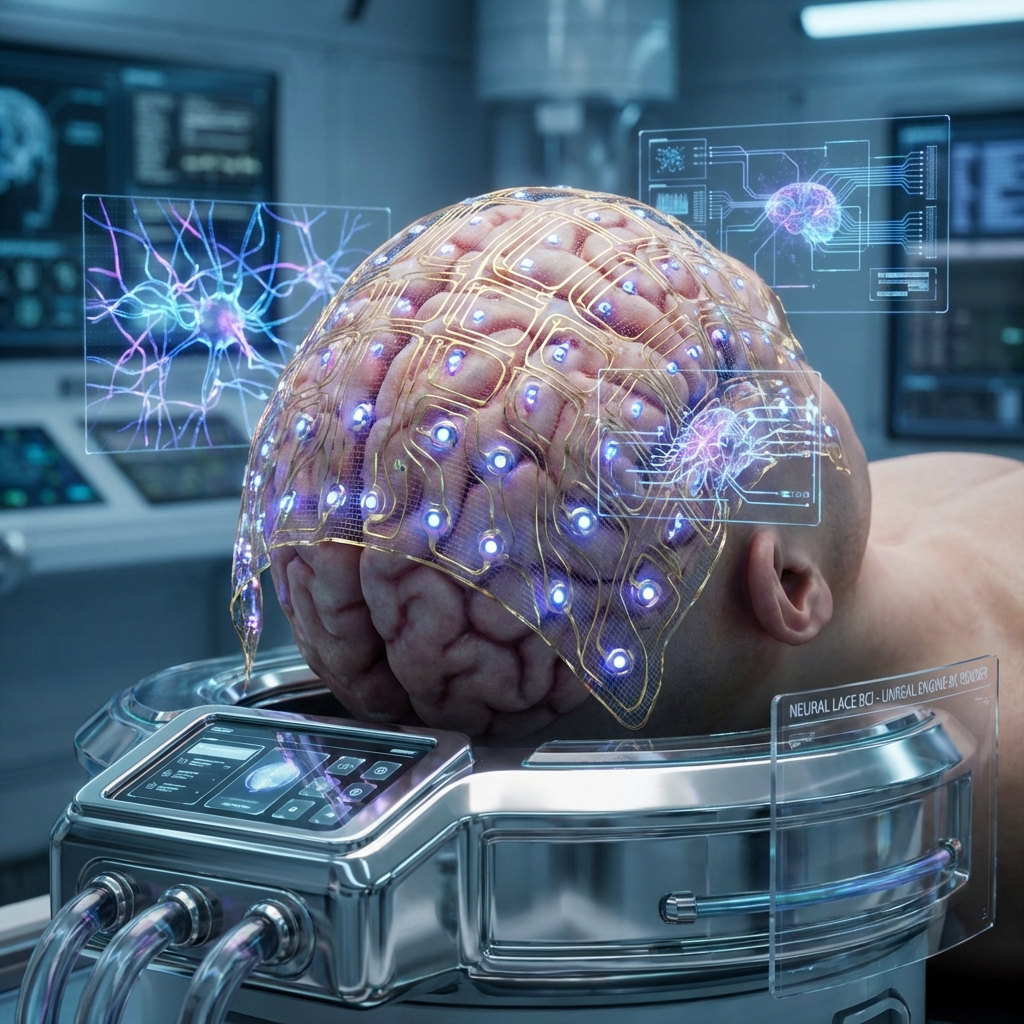
For millennia, the human brain has been the ultimate black box. We could observe its outputs—speech, movement, emotion—but never directly access the computation itself. In 2027, that barrier is dissolving. Neural Lace, a brain-computer interface (BCI) technology, is enabling direct communication between neurons and silicon, creating a symbiosis between biological and artificial intelligence.
This article explores the science behind Neural Lace, its transformative medical applications, the path to Cognitive Augmentation, and the profound ethical questions it raises.
1. The Architecture of Thought: How Neural Lace Works
Neural Lace is not a single device but a network. It consists of thousands of microscopic electrodes woven into a flexible mesh thinner than a human hair. This mesh is injected through a minimally invasive procedure, where it unfurls and integrates with the cortex.
The Interface: Each electrode can both read and write neural signals. When you think "move hand," the lace detects the specific firing pattern of motor neurons. It translates this into a digital command that can control a prosthetic limb, a cursor, or even a drone—all without moving a muscle.
Bidirectional Communication: The revolutionary aspect is the reverse: the lace can also stimulate neurons. This means it can feed information directly into the brain, bypassing the eyes and ears entirely. Imagine "downloading" a language or visualizing data as if it were a memory.
2. Medical Miracles: Restoring What Was Lost
The first and most impactful applications are therapeutic. Neural Lace is giving hope to millions living with neurological conditions.
Paralysis Reversal: Patients with spinal cord injuries are regaining mobility. The lace reads motor intent from the brain and transmits it wirelessly to exoskeletons or stimulators below the injury site, restoring movement.
Sensory Restoration: For the blind, visual cortex stimulation creates "artificial vision." Cameras feed data directly to the brain, rendering images as patterns of neural activity. Early users describe it as "seeing with your mind."
Neurological Disorders: Conditions like Parkinson's and epilepsy are being treated with precision neuromodulation. The lace detects abnormal neural patterns and delivers corrective signals in real-time, preventing tremors and seizures before they manifest.
3. Cognitive Augmentation: The Next Evolution
Beyond healing, Neural Lace promises enhancement. The concept of Cognitive Augmentation is transitioning from transhumanist philosophy to engineering reality.
Memory Expansion: By interfacing with the hippocampus, the lace can act as an external memory buffer. Forget forgetting—every experience, every conversation, every idea can be perfectly recalled. This raises the question: if you never forget, are you still human?
Accelerated Learning: Instead of spending years mastering a skill, neural patterns from experts can be "imprinted" onto your cortex. Want to play piano like a virtuoso? The muscle memory and neural pathways can be transferred. The ethics of "earned" versus "installed" expertise will be fiercely debated.
Telepathic Communication: Two lace-equipped individuals can share thoughts directly, brain-to-brain. This "Neural Network" communication is faster than speech and richer than text, conveying emotion and nuance that words cannot capture.
4. The AI Symbiosis: Merging Minds with Machines
The ultimate vision is not human or AI, but human and AI. Neural Lace creates a high-bandwidth link to artificial intelligence, allowing you to offload computation.
Real-Time Translation: Think in English, and your lace-connected AI instantly translates to Mandarin, feeding the words back to your speech center. You speak fluently in a language you've never studied.
Instant Fact-Checking: During a conversation, your AI co-processor retrieves relevant information from the internet and surfaces it as "intuition." You know the answer before you consciously search for it.
Creative Collaboration: Artists and engineers are using AI to generate ideas, which the lace presents as "inspiration." The line between your thoughts and the AI's suggestions blurs, creating a collaborative creative process.
5. The Ethical Minefield: Privacy, Identity, and Consent
With great power comes unprecedented ethical complexity. Neural Lace forces us to confront fundamental questions about what it means to be human.
Thought Privacy: If your thoughts can be read, who owns them? Can employers require lace access? Can courts subpoena your neural data? The concept of "mental privacy" is being enshrined in new legislation, but enforcement is murky.
Identity Erosion: If your memories can be edited and your skills can be installed, what is "you"? Philosophers are grappling with the Ship of Theseus problem applied to consciousness: if you replace enough of your neural processes with artificial ones, are you still the same person?
Inequality: Neural Lace is expensive. Early access is limited to the wealthy and the medically desperate. This creates a new class divide: the "augmented" versus the "natural." Will cognitive enhancement become a prerequisite for competitive employment, forcing adoption?
6. The Regulatory Landscape: Governing the Mind
Governments are scrambling to regulate a technology that evolves faster than policy. In 2027, the first international framework, the Neuro-Rights Treaty, is being drafted.
Key Provisions:
- Mental Privacy: Neural data is classified as the most sensitive category, requiring explicit, revocable consent for any access.
- Right to Cognitive Liberty: Individuals have the right to modify or refuse modification of their mental processes.
- Anti-Coercion: Employers and institutions cannot mandate neural augmentation as a condition of participation.
Enforcement, however, remains a challenge. Black market lace devices and unregulated clinics are proliferating.
7. The Future: A Post-Biological Humanity?
Looking beyond 2027, the trajectory is clear. Neural Lace is not the endpoint; it is the bridge. As the interface improves, the distinction between "biological brain" and "artificial intelligence" will become meaningless.
The Hive Mind Hypothesis: Some futurists predict that widespread lace adoption will lead to a collective consciousness—a network of minds sharing thoughts in real-time, creating a global "super-intelligence."
Digital Immortality: If your neural patterns can be read and replicated, can your consciousness be uploaded to a computer? The first experiments in "mind uploading" are underway, though success remains elusive.
Conclusion
Neural Lace represents the most intimate merger of humanity and technology ever conceived. It offers the promise of healing, enhancement, and connection, but it also demands that we redefine privacy, identity, and autonomy. We stand at the threshold of a new era—one where the mind is no longer a fortress, but a frontier. The question is not whether we will cross it, but how we will govern ourselves once we do.